|
Alfred William Farley – A Quorn life
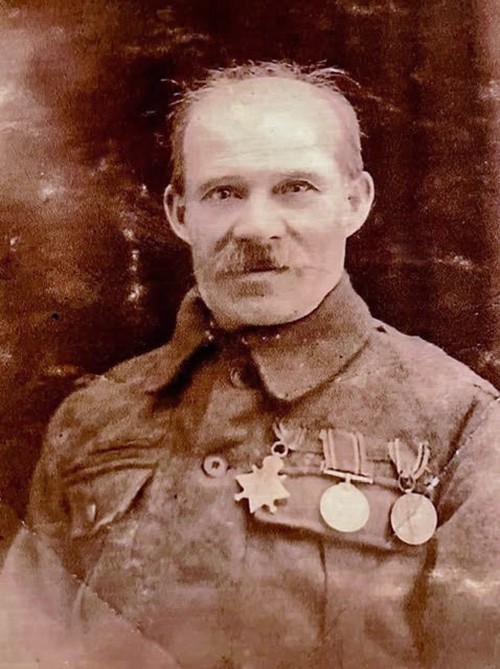
Today almost everyone in Quorn is familiar with Farley Way on the north side of the village, which was named after a well-known Quorn resident, Harold Farley. Perhaps less well-known is his father, Alfred William Farley. The piece below was written by Alfred's great great grandson Matthew Cotterill, who also supplied the photograph.
Alfred William Farley
The name of Alfred William Farley has a strong connection with Quorn, where he eventually made his home and raised his family. But Alfred’s story began much further south, in the streets of London, nearly two decades before the birth of his future wife Sarah Veasey.
Alfred was born on 18th September 1869 at 15 High Street, St Giles, London, the son of Stephen Farley and Selina Braybon. He was one of a family whose lives were closely tied to London, although Alfred’s own journey would eventually take him north to Leicestershire from 1905.
As a young man Alfred became an accomplished painter by trade. Later, and as Britain went to war in 1914, Alfred became involved with military transport and served with the Army Service Corps, later known as the Royal Army Service Corps.
Alfred’s marriage
Alfred married Sarah Veasey in 1904 at All Souls Church, Portland Place, London. Sarah had been born in Leicester in 1873 and had spent part of her early working life in domestic service. There is evidence suggesting that she may have worked as a nanny for the Duke of Hamilton, although the exact details of this part of her life remain the subject of further research.
The marriage brought together two people whose lives had taken very different routes. Alfred had been born in the heart of London, while Sarah came from Leicester. Their marriage would eventually lead them to Quorn, Leicestershire, in 1910 where the Farley family became established. Alfred and Sarah lived for a short time on Station Road, before moving to what is now 11 Loughborough Road in a small ‘two up, two down’ cottage.
Alfred and Sarah had several children. Their family included Harold, who was born in 1907 and would later become a familiar and much-loved figure in Quorn, as well as Angus, Marion, Vera, Arthur and Irene. Angus was born in 1916 but died as an infant. Harold went on to live until 1982, while Vera died in 1991, Arthur in 1987 and Irene in 2011.
World War One
The outbreak of the First World War on 28th July 1914 changed the course of Alfred’s life. Although already in his mid-forties, he enlisted in the Army Service Corps on 18th October 1915, aged 46. His previous experience with transport made him particularly suited to the Army’s growing dependence on motor vehicles and mechanical transport.
Alfred’s wartime service was therefore very different from that of the infantry soldier in the trenches. The Army Service Corps was responsible for the movement of men, equipment, supplies and vehicles, and its mechanical transport personnel played an increasingly vital role in keeping the British Army supplied.
Alfred’s decision to enlist at the age of 46 is an interesting part of his story. By then he was a husband and father, with a young family at home. His son Harold was only eight years old when Alfred joined the Army.
The Farley family’s connection with London did not disappear completely. Alfred’s brother Henry remained in London, and the wider Farley family can be found in records around Marylebone and elsewhere. Henry’s story appears to have ended tragically in 1901, when a man matching his identity was admitted to Marylebone Workhouse on 25 November and died only four days later. Alfred’s own life, however, took a different path.
By the time of the First World War, Quorn had become the centre of Alfred and Sarah’s family life. It was here that their children grew up and where the Farley name would eventually become deeply associated with the village.
Alfred’s later years
Alfred died long before his son Harold became the well-known Quorn character remembered today. Yet in many ways Harold’s story was a continuation of his father’s. The family that Alfred and Sarah established in Quorn produced a son who would serve in the Leicestershire Regiment, survive a remarkable wartime escape from Norway and become one of the village’s best-known characters.
Alfred’s life therefore spans a period of enormous change. Born in London in 1869, when the horse was still central to transport, he lived through the arrival of the motor age, married a woman from Leicester, established his family in Quorn and, in his mid-forties, served in the military during the First World War.
His story is less spectacular than that of his son Harold, whose wartime adventures later became the stuff of local legend. But Alfred’s life provides the foundation for that story: a London-born Farley who travelled north, married Sarah Veasey and established the family in Quorn, leaving behind a family whose name would remain part of the village for generations.
Sarah passed away just after the end of the Second World War in late 1945, and Alfred in early 1947. Their grave can be found in the north-west part of the graveyard at St Bartholomew’s Church in Quorn.
More about Harold Farley can be found in Artefact 1384 and Artefact 800.
| |
|
|
 |
Submitted on: |
2026-10-15 |
|
Submitted by: |
Matthew Cotterill |
|
Artefact ID: |
2654 |
|
Artefact URL: |
www.quornmuseum.com/display.php?id=2654 |
|
|
|