|
John Donaghue - posted to Quorn in 1940
Introduction
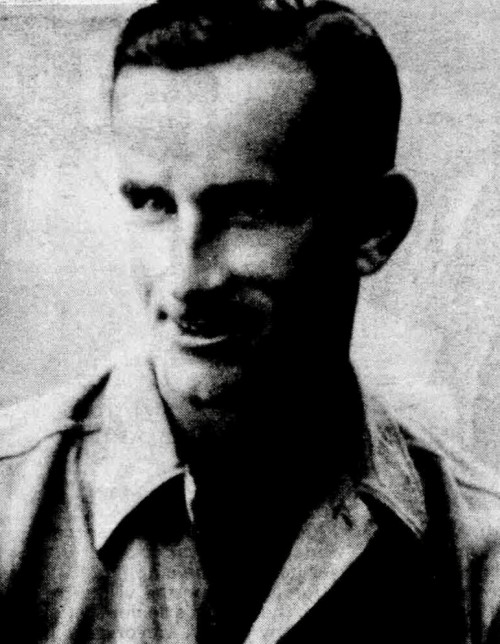
John Donaghue was a freelance journalist and war veteran who, after receiving his call-up papers was posted to Quorn in 1940. In November 1985, he wrote an article for the Loughborough Echo when he was living in Edinburgh. John talks of his time when billeted in Quorn at Soar House, training on Stafford Orchard and bathing in Wrights factory. John is pictured in his days as a young Paratrooper sergeant in Italy in 1943.
Quorn memories
The Military Policeman mentioned in the article by John Donaghue was Military Policeman Bob Gowen. His daughter, Wendy Pervin told us that he was stationed in Quorn, at the time, and met and married a local Quorn girl. After being wounded in Italy in April 1945, he returned to Leicestershire to serve with the Leicestershire Police Force.
1940 - British Paratroopers trained in Quorn.
On the march in armistice poppies with us again. A time when many who served in, and survived World War II turn the odd nostalgic thought to where and when they first went “On Parade!”.
How many Loughborough people even today I wonder are aware that it was in their town’s area, around Nanpantan, Ashby Folville, Gaddesby, Quorn, and Mountsorrel that one Parachute Battalion got its early basic training? The story begins in July 1940. My joining orders were terse and to the point: “You will report to the 50th Battalion Cameron Highlanders, at Loughborough on July 1st.”I was not alone, the overnight packed train from Edinburgh decanted a full load at Loughborough station around 7 am. Breakfast (bacon and eggs) was my first thought, I got it too! Rationing had not yet bitten that deeply. Coming out of the cafe, near the Royal Oak I think, I was confronted by a massive sergeant wearing just as massive a blue hackle in his Balmoral “Are you for the Camerons?” he barked “Yes” I replied. “Then get into that truck at the double, he barked even more fiercely. That was where my civvy status went for a Burton for the next six long years. He picked up 60 of us just like that at random off the Loughborough streets in double quick time. We were destined to form two squads for training and were to be billeted in Quorn. We were first kitted out at Beaumanor, the Battalion HQ. I still remember with great clarity (and: hilarity now) our first “march” from Beaumanor over the short distance to Garats Hay for our first Army breakfast. Bits and pieces of equipment odd boots steel helmets and so on kept falling out from our column as we struggled to control the mass of Army gear we had been landed with.
As the Duke of Wellington said about his troops: “I don’t know what they will do to the enemy but by God they frighten the Hell out of me” We would have scared the pants off anybody that day. And that first Army “breakfast”! coarse bacon rashers floating in inches of fat in tin platters. Even though by this time it was noon there were few takers (a week later and we would have scoffed bacon platters and all!).
Summer 1940 was according to even the older Quorn residents the hottest they had ever experienced. Our training pace was set to match Parades stretched from 7 am to 7 pm with no holds barred. Quorn’s Station Road was our parade ground and its Stafford Orchard our own “personalised” battlefield for things like bayonet fighting. The Quorn womenfolk wept for us! We survived just! Others were undergoing the same regime at Nanpantan, Gaddesby and Ashby Folville, as the battalion was knocked roughly and rapidly into shape. Though time blunts the sharpness of memory many things remain as vivid now as then. We were billeted in Soar House in Quorn, next door to Quorn Hunt property and had dug slit trenches all round as part of our defences. During one German night bombing attack on Coventry some of the horses got loose and fell into the slit trenches. At two in the morning pandemonium reigned supreme as we tried to free the horses and man our defensive positions. Even Jerry would have had to laugh! We got to know every blade of grass on Stafford Orchard and every inch of all the highways and byways for miles around. Mountsorrel provided us (and the villagers) with a safe range to fire for the first time live ammunition. Wright’s factory at Quorn Cross going flat out to produce webbing equipment to make up for Dunkirk losses provided our bath hygiene. Once a week the long wooden dye-troughs in the factory filled with scalding hot water were pressed into service “Soldiers for the use of’. And it was ten soldiers to a trough!
Then there was the Lord Mayor of Leicester’s Spitfire Parade. Every major city at that time was trying to raise funds to buy a Spitfire. Thirty of us in kilt and looking reasonably like veterans took part in that Sunday parade through the city’s streets. That same evening still in the kilt I was a guest at the Brush Club in Loughborough, the hospitality was fantastic. So was the interest of all the Brush lasses in what went on (or off) under the kilt! And many a time as we returned to Quorn after long tiring marches ribald repartee was the order of the day between us and Bob the Military Policeman controlling the traffic at Quorn Cross. Bob was later badly wounded on another crossroads in Italy but recovered and returned to Loughborough and served for many years in the County Police (I hope he reads this). Bob as many in the Camerons also did, met and married a local lass. I was best man myself at just such an Anglo-Scottish ceremony and the happy couple are still very happy in Loughborough. With September and the first frosts came the time for us to leave. Now officially named the 7th Battalion Cameron Highlanders we went right up North to Wick from there in due course to Alnwick via Ayr from there to Dovercourt in Essex and finally to Roman Way Camp in Colchester. It was here that “Boy” Browning paid us a visit. The edict had gone forth from Churchill to form an Airborne force with all speed possible “Would we volunteer?” “Boy” Browning asked us individually the great majority of the battalion did just that. Then it was a quick move to the Airborne base at Chesterfield for intensive ground training and on to Manchester’s Ringway airfield where RAF instructors put us through the hoop for jumping training. They supervised too our first seven jumps which qualified us for our “wings”. That is how the 7th Camerons the bulk of whom had become soldiers for the first time in the Loughborough area made its transition into the 5th Battalion (Scottish) The Parachute Regiment.
Many lasting friendships were formed that Summer of ’40 in Loughborough and around but the abiding impression even today is of the warmth kindness and generosity of the local folks who took many a heart-sick homesick “squaddie” into their hearts and homes. God bless them!
As a Postscript - I could add that nothing - but nothing in the way of hard training I encountered later in the Paras matched the sheer physical torture endured on those first few weeks on Stafford Orchard. - Happy Memories!
| |
|
|
 |
Submitted on: |
2025-12-29 |
|
Submitted by: |
Dennis Marchant |
|
Artefact ID: |
2636 |
|
Artefact URL: |
www.quornmuseum.com/display.php?id=2636 |
|
|
|