|
Winifred Ogston Greenaway of the ATS, Quorn in WW2
Extract from an Imperial War Museum Oral History Interview
Winifred Ogston Greenaway (nee Gauld) was a British private and NCO who served with the Auxiliary Territorial Service (ATS) from 1942, an officer cadet serving with the Officer Cadet Training Unit and then an officer who served with the Y Signals ATS at Woodhouse. She was billeted in Quorn and in 2007 she was recorded for the IMW - Imperial War Museum Oral History Archive. There are five reels, all very interesting but parts of Reels 3 and 4 are those that cover Winifred's time in Quorn. They provide an insight into wartime Quorn probably not heard before. In Reel 3 she speaks of her posting to Quorn, aspects of the period as an officer with Y Signals ATS Unit, accommodation at the old Bulls Head (now 18 High Street), impressions of colleagues; memories of the Quorn Vicar Reverend Pilling; story of a reprimand for not reporting an American soldier; activities on arrival of American Paratroopers in 1944 and their behaviours; standards of turnout of the Americans and pregnancies in the ATS unit; role of the ATS unit; reason for posting in Woodhouse; description of Y Signals offices; duties and daily routine. Reel 4 continues with the problems of the shifts and a visit from psychologists; methods of improving morale including story of a flight in plane; activities in role as Group Army Education Officer; messages passed on to Bletchley Park.
The full oral history interview can be heard at: IWM Interview with Winifred Ogston Greenaway
The whole interview is very interesting, impactful and well worth a listen. Dennis Marchant has transcribed the extract below which covers the main part of Winifred’s time in Quorn.
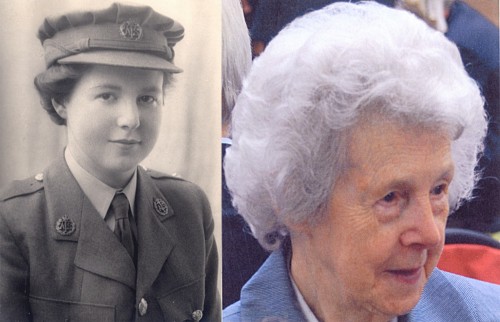
Thanks and acknowledgement are made to the Imperial War Museum, Winifred Ogston Greenaway and David Parr for the photographs of Winifred - one when she was in the ATS and one shortly before she passed away in 2010.
Extract from Winifred's Oral History
‘I was posted to a place called Quorn in Leicestershire. You might as well have told me I was going to Timbuktu. I just knew that it was in the middle of England where there was black clay with no hills and I arrived at Quorn, and I was stationed in a pub called the Old Bull's Head and on the door was a civilian notice which said, "Please note these buildings are not fit for human habitation” and inside in the snug was a woman in uniform, she must have weighed easily 20 stones and she was an expert in communications from the GPO, and in that area then, there were a great number, I say a great number, I don't know if that would amount, to perhaps 60 or 70, I don't know, workers from GPO who knew all about landlines and all that sort of thing. She had no idea how to deal with us; another girl had arrived at the same time as I did. She was there simply because she was an expert in signalling.
So, we had to learn how to be orderly officers and so on, and she was really so sad, and quite soon after that, she disappeared, I should think she was restored to doing the work but in a civilian capacity.
We had a vicar of course, he had to administer to our needs for funerals or weddings or anything and he had the very appropriate name of the Reverend Pilling and it makes me shudder just to think as he, I think he was unctuous, is that the word, and so he found it was his duty to come and visit us once a week and always at the time somebody or other was having a drink, so would you like a drink Vicar and of course Vicar always did. Perhaps I was far too hard on him, me being 21 or whatever it was. But later on, when was it? the 72nd [82nd] Airborne Division, landed near us [1944], he asked to see one of the officers, and I was landed with him. He was going to make a formal complaint so, I sat up a bit straighter and he said he was walking through the graveyard by the church late the night before, and he had heard a noise, and he went to investigate. "And do you know what I found? I found one of your ATS and a member of the American forces copulating under a gravestone. I was, my breath was taken away, he went on “I remonstrated with him, and do you know what that American said? He said, "Oh, shucks, Buddy, shut the gate, will you?” That shocked me, because I wasn't used to talks about copulation. I suppose it was his duty anyhow, the next night or sometime or other. I was on duty to take the girls back from the huts where the interception went on. I’d take them back from the Old Bull where they had supper at midnight coming off duty, back to a house where they lived about a half a mile. In the village we had taken all the big houses in the village, about 250 of us there and about the same number in villages round about. Coming back from meeting the girls, saying good night, Sergeant, and saluting and so on, I was caught by an American, and it took me all my force to get away from him. I was out to supper the next night at another unit, and as a joke I told my opposite number, you know, about this trouble. I made a joke about it. The day after, I was called to the group commander and she said that I hadn't done my duty, that I should have reported the incident. I see now that she was right, but she was very disappointed in me. And this actually became quite a problem. The funny bit was that I was left in charge of the company by chance the day after and the commander of the American regiment came to offer an official apology, which I had to receive, but of course nothing on earth would have persuaded me to tell him. It was really what I thought was such ridiculous situation and it gets more ridiculously the older I get.
Anyhow, the day they arrived [14th February 1944], this paratroop division, they arrived, about half past nine in the morning I think, to their camp, by 11 o'clock, there were several Americans in the village offering the local children six pence’s to show them where the pretty ladies lived, and of course, the little brats naturally pointed out all the ATS houses. I once asked my husband, would it have been the same in the British army and he said emphatically no, not within an hour and a half of arriving. They were troublesome because I was an admin officer there and I had to do the discharges for pregnancies, and one did wonder what Marjory Smith would make of being Marjorie Kopinski and going off to America. I think some of them survived. But what they did was to invite the ATS to a dance on Saturday night, as they went in each girl was given a bar of chocolate, which was gold, and a pair of nylons, which were unheard of and so they very quickly got the ATS well-disposed to the Americans. They, of course, looked marvellous because they were first seen coming across the meadow when the May blossom was out. They were all at least six feet one and they were wearing their helmets, and they all had a branch of blossom that was stuck behind their ears, and they moved with such ease, they hadn’t the formality of the British soldiers who marched with their arms straight, not just slouching.
But I don't know how many pregnancies we had, certainly, while they were there, there seemed to be, what, 20 times more than usual because of course, some of the women who were married and whose husbands came on leave, got honourable discharge if they became pregnant. And it was those men who you've heard of the story of the parachutist, who was caught in the belfry of St. Mere Eglise, near Caen, there’s a museum there about it. It was that lot of people and they had heavy casualties. Yes.
Anyhow, I didn't mention the fact that Y signals meant many signings of the Official Secrets Act because we were on interception for the whole of the war. Quorn which has Woodhouse Eaves which is the next village where there was a big house which had been chosen because it was supposed to be furthest from the sea and in a very, very secluded spot and accessible, from the point of view of radio waves. Around this house were built the huts that looked like ordinary army huts, but inside they had artificial walls. Some were, of the huts were in the shape of cattle sheds or farm buildings, but inside we had thick walls and as well as I remember about 24 wireless sets where the girls sat, listening to Morse for seven hours at a time and each girl had about six lines of Morse, and she had to pick out one.
Have you ever listened to Morse? So, it's high pitched and you have to pick up the pattern of the letters. It's intense concentration and some of them, well, they all were well educated girls, they all had, I should think, what we call GCSE’s and A levels now. And they went to this hut, say at seven in the morning and came off, I’ve forgotten now, early afternoon, seven-hour shifts, I think.
The shifts proved a problem, I think, will always do so because when the war was at such a bad stage, there was a lot of sickness, well, not a lot, but high for a unit of that kind, which had to have everybody on duty. And so, we got, we were invaded by a team of psychologists from the War Office.
By this time, I was at group headquarters as an education officer, and they came along at the end of the shifts of the one of the teams. When everybody was really, really tired, and said things like, "Are you enjoying your work? Do you find it tiring? And the visit created a mental upset through the whole unit. So much so that our group commander who was a Guinness and a blonde, a very forceful woman, and she went to the headquarters at Woodhouse Eaves and tackled the commander of the whole place, who was at ex-Navy, Illingworth. She was absolutely furious, and he was, too.
Anyhow the upshot of this, it was just so stupid, the upshot was that the shifts were changed yet again. Kind of what you have probably heard of nurses or doctors, if you have long spells of night shift and the short spells you become all disturbed insides. So, we tried various methods, one of which included being off for three days on end, and I was told to do things with the girls from each of the units to take their mind off the work. So, I enjoyed doing this and did all sorts of things like visiting a coal mine where there was a new, the first pit head baths and we were invited to cut the ribbon, you can imagine the frivolity, but it cheered up the girls and was a definite change of scene, seeing what 100 tough miners. Then we were allowed down, and my goodness what a grim way to work, that awful, awful darkness and the silence from things that were going on, and the poor donkeys.
So, the girls would have a whole day out at a time and one day we visited an airfield, and we were shown the planes, and they were coming on and off, sorties, at Castle Donnington, and the pilot, who was in charge of the flight line party of 30. He said, "Would you like a spin?” And he was about my age, and without a second thought, I said, "Of course, we would” and he took us up.
Buzzing around the country when he said he had a message from his CEO, he was regarded as a taking an unscheduled flight, and he would have to find somewhere else to land. So, I was worried then because the girls had to be back to go on shift at 5 o’clock. The girls didn't mind a bit. This was quite exciting, and he had to buzz around quite a bit to find a nearby airport. But then, of course, our coach, our transport was at Castled Donnington so we had to wait for that to come and fetch us and so as soon as we got back, the CO wanted to see me and said I was irresponsible, what would have happened if there had been an accident, what about the insurance claims and so on and so forth? And then, in the end I got a bit tired of this, because I got the message, I got the message when I went with the first CO rang up his pilot. I said, "What could you have done, mam?” So, she said, "Get on with you.” So that was the end of that.’
| |
|
|
 |
Submitted on: |
2025-09-12 |
|
Submitted by: |
Dennis Marchant, photographs from David Parr |
|
Artefact ID: |
2622 |
|
Artefact URL: |
www.quornmuseum.com/display.php?id=2622 |
|
|
|